LocalPMOS
The Company Brain for Autonomous Software Teams
LocalPMOS is an AI-native operating system that continuously captures company context, identifies risks and opportunities, prioritizes work, and converts decisions into executable actions.
Overview
Software organizations are drowning in context.
Product managers, engineers, founders, and operators spend hours every day switching between Slack, GitHub, Jira, customer feedback tools, meeting notes, dashboards, and documents just to understand what is happening and decide what to do next.
LocalPMOS turns fragmented company context into organizational memory and operational intelligence. It acts as an always-on AI Product Manager that reasons across product, engineering, customer, and business signals, then turns recommendations into concrete actions.
Problem
A typical product manager spends 20 to 40 percent of their week gathering information rather than making decisions.
As teams grow, critical knowledge becomes fragmented across tools and people. Decisions become disconnected from outcomes, onboarding slows down, and organizations repeatedly lose context as projects evolve and employees leave.
Teams frequently struggle to:
- Understand what changed across Slack, GitHub, Jira, docs, and meetings
- Connect customer feedback to roadmap decisions
- Identify launch risks before they become blockers
- Prioritize work with incomplete context
- Preserve institutional memory across projects and team changes
- Turn decisions into follow-up actions
The problem is not a lack of tools.
The problem is that no system truly understands the full context of the business.
Initial Customer Profile
Our initial customers are software startups and technology companies with 10 to 500 employees.
These organizations have enough complexity that coordination becomes expensive, but not enough management layers to maintain a shared understanding of what is happening across the company.
Founders, product managers, engineering leaders, and operators are constantly making high-impact decisions with incomplete information.
LocalPMOS is especially useful for:
- AI-native startups
- Fast-growing software teams
- Product-led companies
- Remote or distributed teams
- Teams managing complex launches
- Teams with heavy Slack, GitHub, Jira, and customer feedback workflows
Market Opportunity
Companies already spend billions of dollars annually on collaboration, project management, knowledge management, workflow automation, and productivity software.
Yet most tools focus on storing information, assigning tasks, or tracking work.
The opportunity is to build the intelligence layer across company systems. LocalPMOS transforms fragmented information into persistent organizational memory, decision support, and autonomous execution.
This begins with product management, but the same architecture can expand across engineering, sales, recruiting, operations, finance, and customer success.
Solution
LocalPMOS continuously monitors company context, identifies risks and opportunities, prioritizes work, and converts decisions into executable actions.
Unlike traditional AI assistants that simply answer questions, LocalPMOS acts as an operator.
It can:
- Analyze Slack messages, GitHub issues, Jira tickets, customer feedback, meeting notes, and project docs
- Identify launch risks and blockers
- Recommend roadmap priorities
- Generate PRDs, Jira tickets, acceptance criteria, and stakeholder updates
- Create reminders and follow-up tasks
- Track execution over time
- Preserve decisions and outcomes as organizational memory
Our goal is to reduce the time knowledge workers spend gathering context by more than 50 percent while improving organizational memory and decision quality.
Instead of asking, "What should we do next?", teams receive proactive recommendations grounded in the complete context of the organization.
Demo
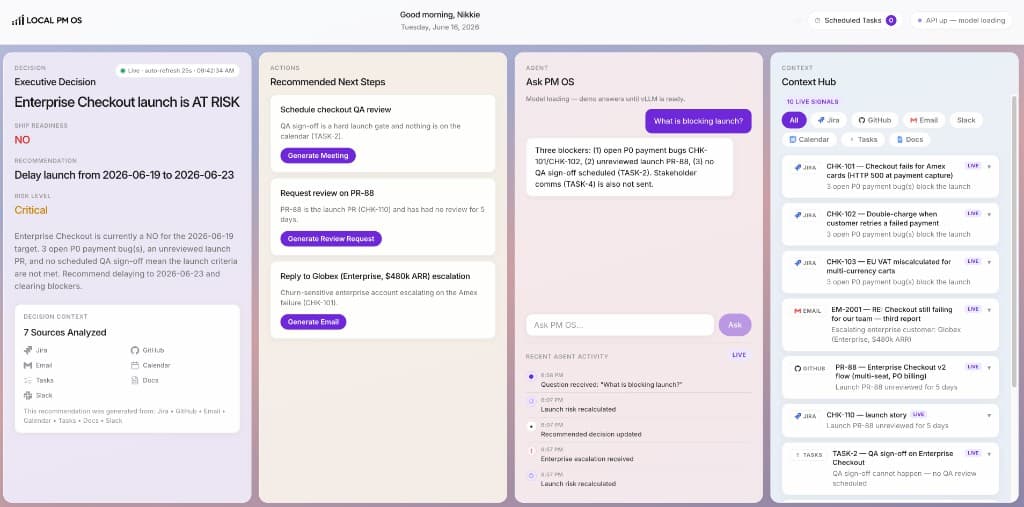
In our prototype, LocalPMOS analyzes project context and identifies a launch-critical decision.
For example:
Enterprise Checkout requires a go or no-go decision. The system detects that the launch depends on QA sign-off and zero open P0 issues, then creates an actionable reminder inside Apple Reminders.
This shows the agent moving beyond analysis into execution:
Context
→ reasoning
→ decision
→ task
→ real-world follow-up
The demo proves that LocalPMOS is not just a dashboard. It is an operating layer that turns company knowledge into action.
Why Now
The amount of organizational context generated by software teams is growing exponentially.
Every day, companies create thousands of Slack messages, GitHub commits, Jira tickets, customer conversations, meeting notes, and AI-generated artifacts. Yet most of this knowledge remains trapped inside disconnected systems.
At the same time, frontier AI models have become capable enough to reason across large volumes of information and participate directly in operational workflows.
The missing piece is not intelligence.
It is memory.
Vision
We believe the most valuable asset inside every organization is its accumulated knowledge, decisions, and outcomes.
Today, that organizational memory is scattered across tools and people. Every time an employee leaves, a project ends, or a decision is forgotten, the company loses part of its intelligence.
LocalPMOS is building a persistent company brain that continuously captures institutional knowledge, learns from execution, and becomes more effective over time.
Product management is simply the first environment.
The same memory and decision-making architecture can be applied to engineering, sales, recruiting, operations, finance, customer success, and eventually every function inside an organization.
Long-Term Opportunity
We believe the next generation of software will not be a collection of disconnected tools.
It will be a continuously learning operating system for organizations.
A company brain that compounds knowledge, reinforces successful behaviors, learns from outcomes, and enables increasingly autonomous teams.
As AI agents become more capable, organizations will need more than assistants. They will need systems that remember, learn, and make better decisions over time.
Our goal is to build the memory layer and operating system that powers the autonomous organizations of the future.
Team
- Eddy—AI / Machine Learning Engineering
- Nagisa Ikeda—Product Management, AI Design Engineering
- Jiawen Zhang—AI Engineering, Implementation